


One of the raging debates in America now is the contention by certain groups that mobile devices, mainly cellphones, but also tablets should be banned in schools because of the distractions they provide students. Some school officials and parent groups are making the argument that texting and social media, etc. are interfering with kids’ learning. It’s a valid point but I’m going to offer a partial rebuttal.
Other parents have argued that cell phones offer a good way for parents to keep in touch with their kids and that’s an excellent point too.
I’m going to also offer the following argument, that mobile devices offer a virtual sea of knowledge that users can tap into. Obviously the first is the internet, in which you can do serious research on any subject. Wikipedia is one of my favorites but there is also the online version of the Encyclopedia Britannica which you can view for free with annoying ads or buy a subscription to remove the ads. Pricing: Monthly $8.99, Annual $$74.95, Family Bundle $99. True, Wikipedia isn’t infallible but I find it pretty reliable. And it’s true that some of their science/technical articles can be overwhelming and right off the bat jump right into a series of differential equations and sometimes I think if I understood the subject at that level I wouldn’t be looking it up in Wikipedia in the first place! So I then search out the information on other websites which surprisingly can be more accessible. But I realized that there are two factors at play. One is that the science/technical articles are a good resource for college/grad/PhD students. Secondly, you have to realize that Wikipedia researchers/writers don’t get paid.
Then there’s an amazing access to ebooks. Mostly I use Apple’s Books app, but also the Amazon Kindle one as well.
Obviously on both apps you have access to millions of books. Apple’s Books doesn’t have as many books as Amazon of course, but I find it meets most of my book needs. And amazingly they give out freebies from time to time, like literary classics that are now in the public domain. Just recently: The Count of Monte Cristo, Pride and Prejudice, The Art of War, The Great Gatsby, The Brothers Karamazov, The Iliad, Anna Karenina, The Invisible Man, among others. Although the free Complete Works of Lewis Carroll had inferior illustrations so I ended up buying a version for 99 cents which has the original John Tenniel illustrations!
And finally there are the incredible educational apps that you can download for mobile devices. As I have mentioned in previous posts there are apps that can identify plants, trees, mushrooms, birds, animals, and minerals. There are also many astronomical apps. For instance there are a lot of sun and moon apps, which allow you to see a daily display of sunrise/sunsets and moonrise/moonsets, as well a lot of additional information as well. I have the SolarWatch app which also shows you the correct Solar Time as well as twilight times. The Deluxe Moon app shows phase, zodiac, astronomical viewing data, current distance from Earth info (!), etc. The MeteorActive app shows upcoming meteor shower and sporadic meteor events. But my favorite is the Sky Tonight app which is insane! It actually displays a real time depiction of the night sky based on your position. Not only does it show major stars, constellations and the Ecliptic it also shows the sun, planets, the Magellanic Clouds, (some) satellites, the Hubble telescope, and the ISS! And what is really rad is that it can “see” through the Earth, if you point your device below the horizon it will show you the sky “below” your location, in other words it shows the entire 360 degree sky as seen from the Earth.
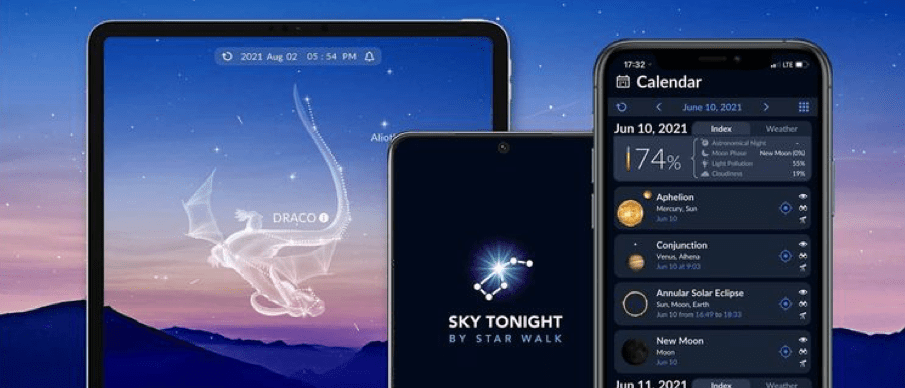
These are some of the ones I have. Of course nowadays they have educational apps for every subject.
In closing I’d just like to say that I’m presenting a counter argument to the prevailing notion that mobile devices are “obviously” a bad idea for students, but it’s also true I could see the argument that they could be a distraction in a classroom.
 Munedawg Communications
Leave a comment